
Key Takeaways
With the arrival of spring and university application season just around the corner, secondary school juniors have the opportunity to take an honest look at how their marks and test scores align with the universities on their list. While some students are well-calibrated in their expectations of incoming student profiles for the universities on their list, others may be surprised to find that they are below standard for the most selective universities on their list. Reality checks are important and necessary. The well-informed, well-calibrated student is in a far superior position. Accurate information allows a student to make necessary adjustments to courses, test preparation, and their university list.
Using scattergrams to calibrate expectations
The best way to align expectations is by getting the most accurate information available. When available, scattergrams provided by companies like Naviance (owned by PowerSchool), Scoir, and Appily (formerly Cappex) allow a student to visually compare how their marks and test scores align with those of other students who have previously applied to particular universities. Scoir and Naviance provide the most granular information, putting a student in the context of their peers from their secondary school.
When a student pulls up a scattergram to see how other students with similar marks and scores have fared in the admission process, they will get a clearer picture of their admissions odds. If a student finds that their GPA and test scores place them in a sea of red x’s, indicating rejections, that’s critical information: there’s work to be done. Similarly, for a student who finds their GPA and testing put them in a sea of green, indicating prior acceptances, this can engender a greater degree of confidence that the student is on-profile for that particular university. While the use of scattergrams can discourage certain students from applying to elite universities, they can also light a fire and elicit meaningful behavioral change for the motivated student.
Using the Common Data Set to calibrate expectations
While not all students have access to Scoir or Naviance, they can look up detailed information about accepted students through the Common Data Set (CDS). Every year, universities publicly share admissions data via the CDS, which can help students calibrate their likelihood of admission. Our colleagues at University Transitions maintain a CDS Repository, which is incredibly helpful.
Using the Common Data Set is fairly straightforward. Say a student is considering applying to the University of Michigan and wants to examine how they stack up against current students. They can access the Common Data Set for Michigan for the class of 2024. Section C provides comprehensive data on enrolled students: section C-9 provides highly detailed information on test scores, and C-11 provides detailed information on secondary school GPA. Among Michigan's current first-year class, 52% of students submitted SAT scores, with an average score of 1470 and a middle 50% ranging from 1350 to 1530. 18% of students submitted ACT scores, with an average score of 33 and a middle 50% ranging from 31 to 34. Given this data, a typical student with a 1300 SAT or 30 ACT still has some work to do to get their testing in a competitive place. Section C-11 provides a breakdown of the secondary school GPAs of the current first-year class:
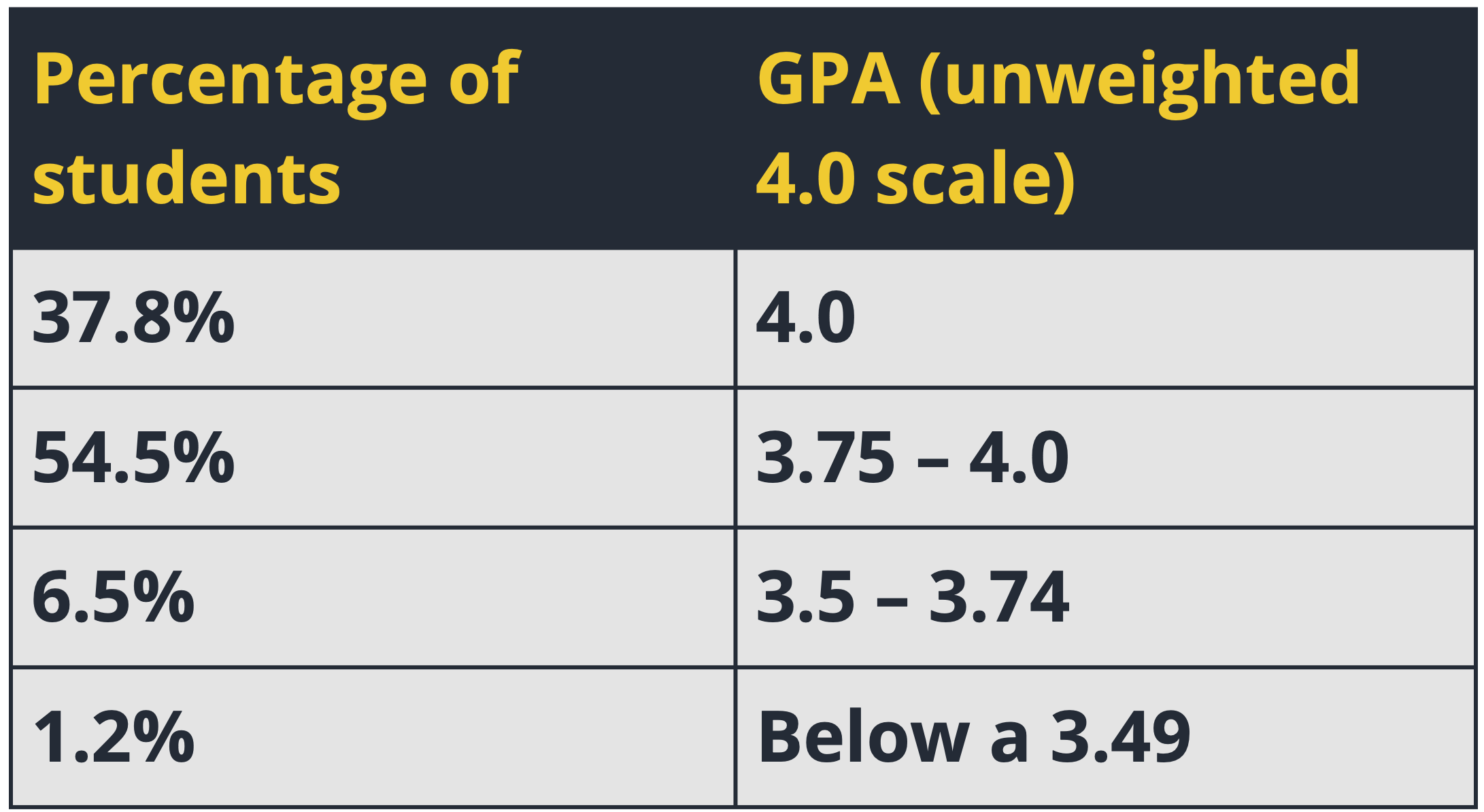
The student with a GPA below 3.75 is not in great company for Michigan, as a mere 7.7% of enrolled students fall into this category.
Facts are friendly. Data helps clarify and calibrate. If a student is below profile, the next question is, what can a student do about it?
Marks
When it comes to marks, juniors can only move the needle so much, given that they have 2.5 years of marks already locked in. But they can certainly finish strong and show admissions officers that they are ready for the type of rigorous courses they will see at university.
Students can bring focus, energy, and strategic planning to their finals and AP/IB exams. This last stretch is the final push to boost the GPA that admissions officers will see when they review early applications in the fall. For more information on this topic, please check out this article specifically addressing Year 12 marks.
Testing
While GPA is only slightly malleable at this point, test scores are in a completely different category. Between now and submission deadlines, students can make tremendous progress on their SAT and ACT scores.
For students on the ACT track, there are five test dates between now and regular admissions deadlines. Students applying early have at least three and potentially four remaining test dates, depending upon whether universities will accept the October 18 ACT, given their deadlines.
Upcoming ACT dates:
- June 14
- July 12
- September 6
- October 18
- December 13
Note that all ACTs given in September, October, and December (both digital and paper administrations) will be in the new “Enhanced ACT” format, in which students will have a shorter test with fewer questions and more time per question.
The SAT now offers 7 testing dates between now and regular admission deadlines, given the recent addition of the September SAT. Students applying Early Action or Early Decision still have 5 eligible test dates ahead of them.
Upcoming SAT dates:
- May 3
- June 7
- August 23
- September 13
- October 4
- November 8
- December 6
Given the abundance of test dates, students will have ample opportunity to prep, test, and retest before applications are due.
Next Steps
Now is the time for students to put their marks and scores in context and make necessary moves to optimize their odds of admission. When it comes to testing, students should look up those middle 50% SAT/ACT ranges for their target schools and get a clear sense of whether their test scores are going to be an asset or a liability in their application. Students should verify if they are solidly on profile or closer to the bottom quartile of students. If there’s a gap, it’s time to get a plan in place to move the scores. There’s plenty of time to close that gap, particularly with the addition of the September SAT, which is a pivotal testing opportunity. Students can use part of their summer to focus their energies and see substantial gains by fall deadlines. When it comes to secondary school marks, there is no time like the present, and these next two months are critical. Students who end the semester strong will put their best foot forward in the admissions process.
Please don’t hesitate to reach out if your students need support in either of these areas.

Explore our programmes

Book a Test Prep Consultation

Book a College Consultation


.jpg)
.jpg)